GAINS-Italy at high-resolution for policy-oriented air quality assessment in Italy
In a study published in Atmospheric Environment, ENEA enhanced the GAINS-Italy system by increasing the spatial resolution of pollutant concentrations to 4 km, enabling air quality assessments to support policymaking.
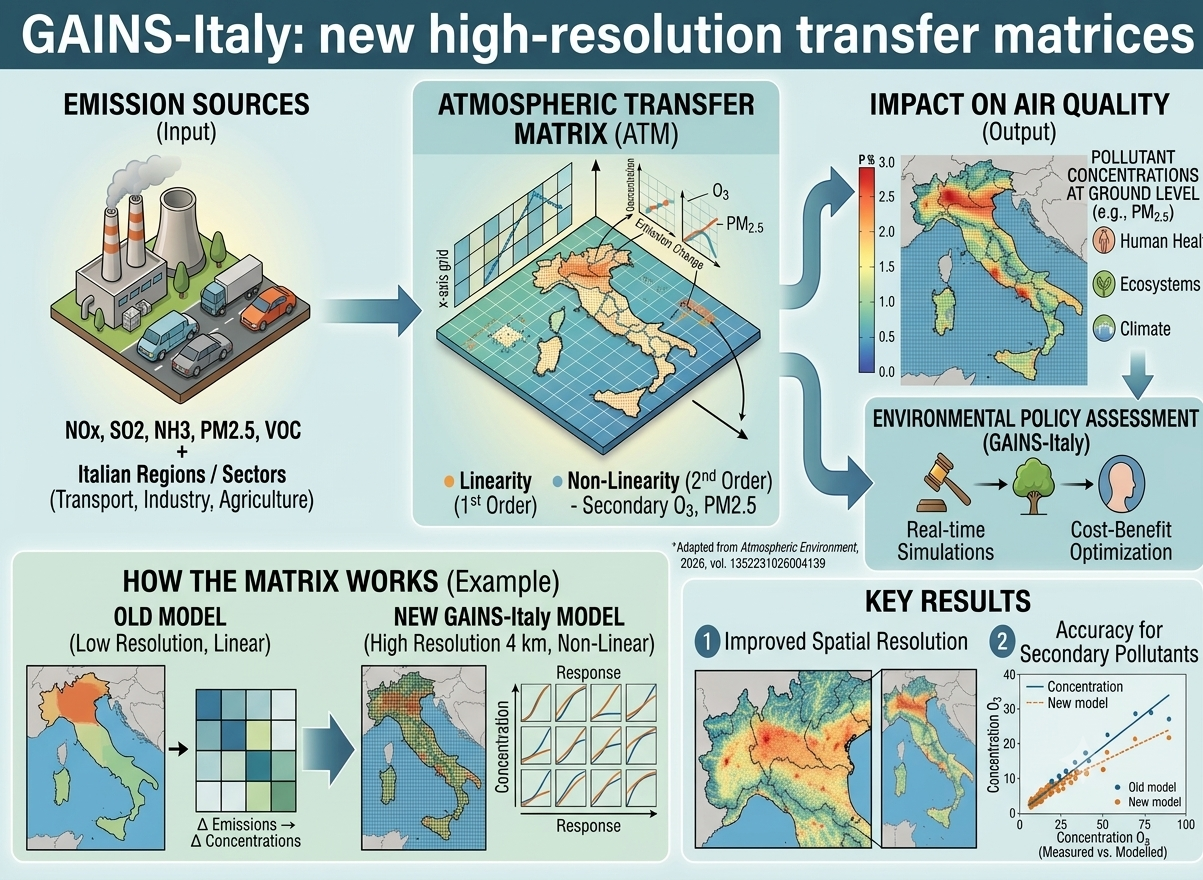
In particular, Atmospheric Transfer Matrices (ATMs)—source-receptor relationships used to rapidly estimate air quality responses to changes in emissions of key atmospheric pollutants (SO2, NOx, PM, NH3, and NMVOCs)—have been enhanced. ATMs enable rapid analyses aimed at evaluating policies and measures that would otherwise require full-scale, computationally intensive simulations using chemical transport models.
In this study, we present an updated set of ATMs covering the entire national domain at a 4 km resolution, incorporating selected second-order terms to account for non-linear responses. The results demonstrate that first-order ATM models are adequate for quasi-linear processes, whereas the inclusion of second-order terms improves agreement with full chemical transport model (CTM) simulations for non-linear indicators—such as particulate matter and ozone—reducing discrepancies to within a few percentage points. The proposed approach allows for near-real-time scenario screening while preserving the spatial structure, magnitude, and accuracy of the responses, thereby providing a practical tool to support national and regional air quality planning.