
Project RIVIERADE
Improving Modelling Methods to Produce Climate Services for Resilient European Seas and Coasts in a Decadal to Multi-Decadal Horizon
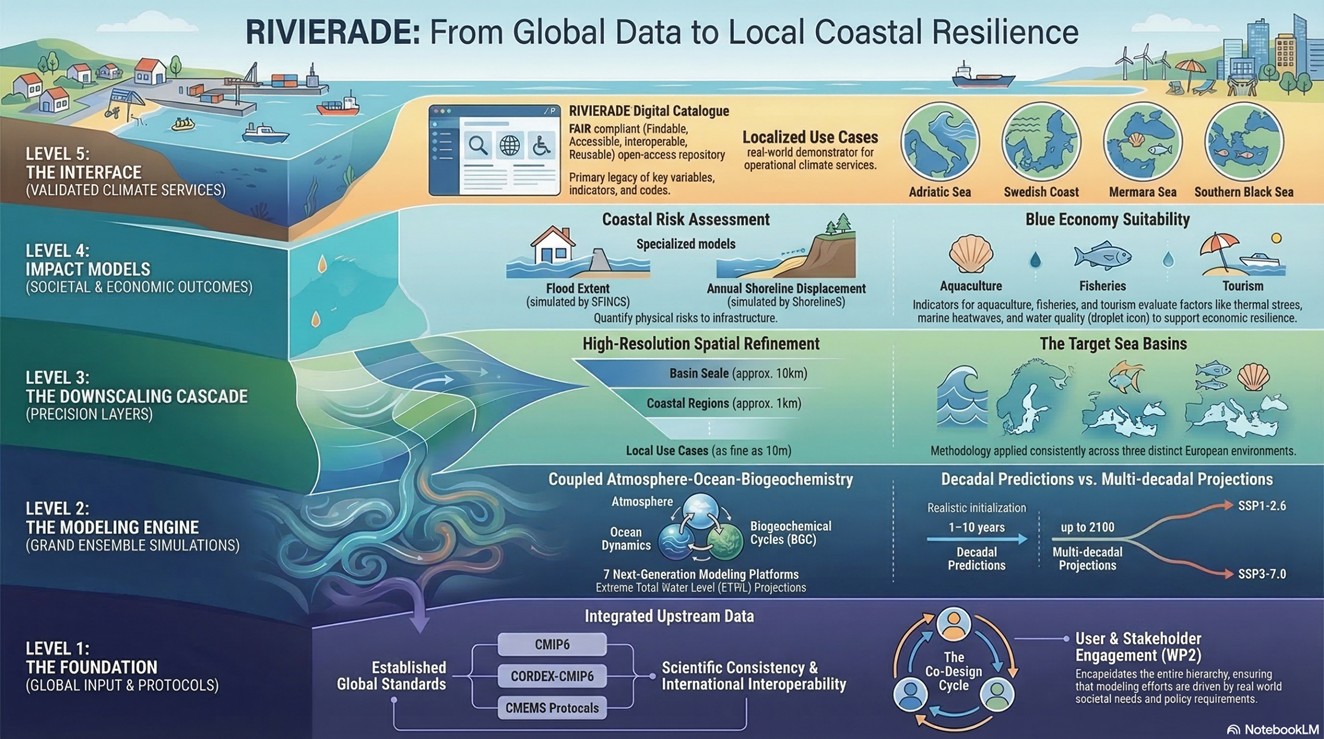
Delivering validated climate services for resilient European Sea on a decadal to multi-decadal horizon is a challenge. RIVIERADE brings together the scientific communities geared into CORDEX and the Copernicus Marine Service and capitalizes on their unique scientific experience to develop and implement a pre-operational and replicable multi-model framework and protocols to produce, downscale, assess and deliver state-of-the-art decadal predictions and multi-decadal projections of climate change and related impacts on marine ecosystems, covering the basin scale and the coastal areas, up to, and including, development and demonstration of climate services. RIVIERADE will target three European Seas (Baltic, Black, Mediterranean), to produce data and information for ocean health, sustainable blue economy, and coastal climate risks, downstreaming the data flow from climate ensembles to coastal areas at different spatial resolutions and for selected areas, in a circular process based on users and stakeholders engagement, co-design and assessment of innovative climate services. The proposed methodology will employ high-resolution regional Earth Systems, ocean, marine ecosystem, and impact models of different complexity and will include both traditional and new ocean modelling approaches with the final objective of delivering: (i) coordinated and harmonized multi-model datasets of high-resolution decadal and multi-decadal scenario simulations for the three European target seas (ii) demonstrators of climate services at European Sea basin scale (3 seas), coastal regional (4 subregional areas) and local (4 local use cases) scales. These datasets, together with the framework proposed to produce the coastal climate services, and the portfolio of Delivering validated climate services for resilient European coastal areas on a decadal to multi-decadal horizon represents a challenge in the development of the EU Green Deal and the setting up of reliable digital twins for the ocean.
The EU-funded RIVIERADE project aims to work with climate scientists, oceanographers, and marine modelers to create reliable climate forecasts. Their focus is on the Baltic, Black, and Mediterranean Seas. The project will introduce a framework that evaluates the effects on marine ecosystems and delivers useful climate services. It will use Earth system, ocean, and ecosystem models to produce datasets and projections at local and basin scales. Overall, the project supports ocean health, sustainable blue economies, and coastal resilience. The aim is to transform climate forecasts into practical tools for Europe’s coastal communities.
I partners di progetto sono:
Istituto Nazionale Di Oceanografia E Di Geofisica Sperimentale (OGS), Italy
Centre National De La Recherche Scientifique Cnrs (CNRS), France
Fondazione Centro Euro-Mediterraneosui Cambiamenti Climatici (Fondazione CMCC), Italy
Stichting Ihe Delft Institute For Water Education (Ihe Delft), Netherlands
Leibniz-Institut Fur Ostseeforschung Warnemunde, Germany
Sveriges Meteorologiska Och Hydrologiska Institut (SMHI), Sweden
Agenzia Nazionale Per Le Nuove Tecnologie, L'energia E Lo Sviluppo Economico Sostenibile (ENEA), Italy
Universite De Liege (Uliege), Belgium
Middle East Technical University (Metu), Turkey
ENEA (SSPT-CLIMAR) ha il ruolo di partner del progetto che è coordinato dall’Istituto Nazionale di Oceanografia e di Geofisica Sperimentale - OGS. Le attività di ENEA prevedono:
- il coordinamento delle attività per la co-progettazione dei prototipi dei servizi insieme agli utenti (WP2 sul codesign di Servizi Climatici),
- il contributo alla produzione di simulazioni climatiche multi-decadali ad alta risoluzione per il Mediterraneo tramite il suo modello climatico ENEA-REG,
- l’implementazione del modello biogeochimico Darwin accoppiato con il modello di circolazione oceanica MITgcm.
In particolare, sono previste le seguenti azioni: costruzione del modello fisico; implementazione della componente biogeochimica; produzione dei forzanti meteorologici; realizzazione della simulazione di hindcast.