
Final Event of the ForestNavigator Horizon Europe project
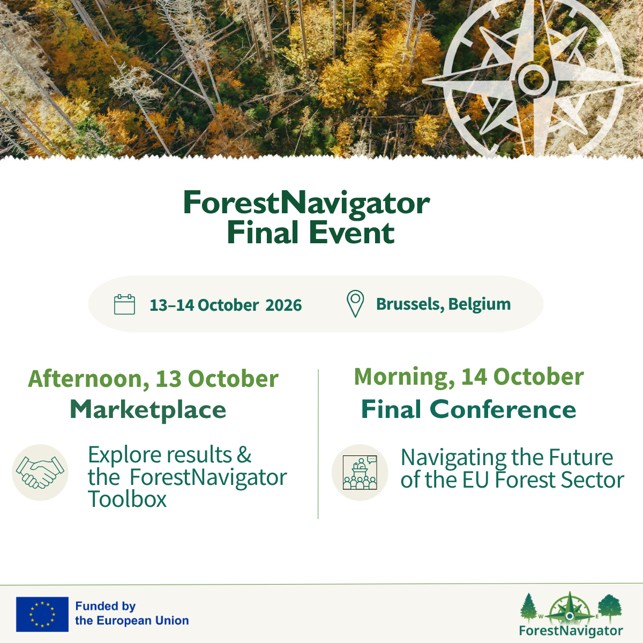
On 13–14 October 2026, following four years of research and collaboration, Brussels will host the final event of Forest Navigator, the European project dedicated to developing tools, data and scenarios to support forest policymaking. Researchers, policymakers, industry representatives and stakeholders will come together to discuss the project’s achievements and how the tools developed can support the future management of forests across Europe.
| Event type | International meetings |
|---|---|
| Attendance | Hybrid event |
| Event starts |
10/13/2026 - 13:00 Add to Calendar |
| Event ends | 10/14/2026 - 13:00 |
| Location |
Brussels, Belgium More info Nhow Brussels Bloom Rue Royale Koningsstraat 250 Directions |
| Useful links | |
| Reference personnel |
Following four years of research and collaboration, Forest Navigator is coming to a close with a final event taking place in Brussels on 13–14 October 2026. The event will provide an opportunity to present the project’s main findings, explore the tools developed and discuss their potential contribution to future European and national forest policies.
The two-day event will bring together researchers, policymakers, industry representatives and other stakeholders interested in the future of European forests, fostering dialogue between research, public policy and the productive sector.
The programme includes an interactive “Research Marketplace” on the first day, followed by the final conference, “Navigating the Future of the EU Forest Sector”, on the second day.
ENEA will be represented by researchers Melania Michetti and Fabio Eboli from the ENEA | Department for Sustainability. Among the scientific contributions presented at the ForestNavigator Research Marketplace, Melania Michetti will illustrate ENEA’s work on the ecosystem-based assessment of the cultural and recreational services provided by forests. The analysis aims to incorporate these benefits, which are often difficult to quantify in economic terms, into integrated forest system modelling, contributing to a more comprehensive representation of the economic value of the forest sector.
Considering not only the productive functions of forests but also the recreational and cultural benefits they provide can broaden our understanding of their contribution to society. It can also provide a stronger basis for assessing the impacts of forest policies and exploring possible future scenarios.